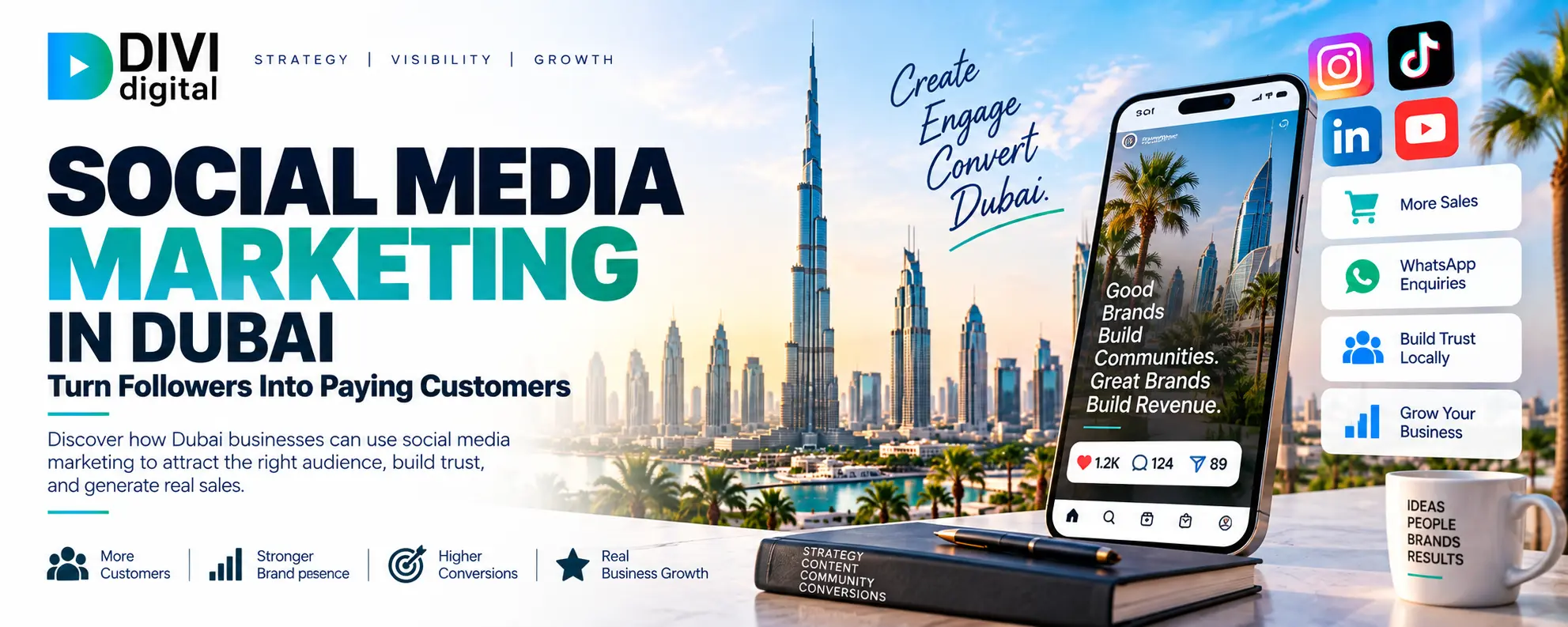
A large following looks good on a dashboard. It doesn't pay the rent.
Plenty of Dubai brands have thousands of followers and still struggle to close sales. The gap usually isn't content quality — it's strategy. Likes and comments feel like progress, but they're not revenue. If your social media marketing isn't built around a clear path from scroll to sale, you're building an audience, not a business.
This guide breaks down how to actually convert Dubai's highly active social media users into paying customers — with the local realities most generic advice ignores.
Why Generic Social Media Advice Doesn't Work in Dubai
Dubai isn't a typical market. Most social media playbooks are written for a single-culture, single-language, single-payment-system audience. Dubai is none of those things.
Consider what makes the city's digital landscape different:
- Extremely high social penetration. UAE residents are among the most active social media users in the world, spending hours daily across platforms.
- A multicultural buyer base. Expats from South Asia, Europe, Africa, and the Gulf sit alongside Emirati nationals — each with different habits, languages, and trust signals.
- A luxury-meets-value economy. The same city hosts ultra-premium D2C shoppers and highly analytical B2B buyers in real estate, finance, and consulting.
- Regulatory oversight. Commercial advertising and social selling fall under UAE Media Council rules, and running paid campaigns without the right permissions can get accounts flagged or fined.
A strategy copied from a US or UK case study will miss all of this. If you want followers to convert, the funnel needs to be built for Dubai specifically — not adapted after the fact.
Get Your Compliance Foundation Right First
Before a single dirham goes into ads or influencer deals, sort out the legal groundwork. This is the part almost every "how to sell on social media" guide skips, and it's exactly where Dubai businesses get tripped up.
- UAE Media Council registration. Businesses and individuals running commercial content or paid promotions in the UAE generally need Media Council approval. Skipping this isn't a minor technicality — it can affect your ability to run ads at all.
- A valid trade license for e-commerce. If you're selling directly through social channels, a DED trader license (or equivalent) should back the transactions.
- Data handling compliance. UAE data protection rules govern how you collect and store customer information gathered through DMs, forms, or checkout flows. Automated lead capture tools need to respect this from day one.
Get this sorted early. It protects the business and it's far easier to build a scalable funnel on solid legal ground than to retrofit compliance after your account gets restricted. A digital marketing partner who already operates within these rules can save you from expensive missteps.
Building a Dubai-Optimized Conversion Funnel
Followers don't become customers by accident. They move through stages, and each stage needs a different kind of content and a different call to action.
Top of Funnel: Get Noticed the Right Way
This is where most Dubai brands actually do fine. Reels and short-form video showcasing lifestyle, product-in-use, and local context perform well because they match how people already browse.
What works:
- Short, visually rich Reels and TikToks set in recognisable Dubai contexts
- Hooks in the first two seconds — scroll speed here is unforgiving
- Content that reflects the diversity of the audience, not just one demographic
Middle of Funnel: Build Real Consideration
This is where vanity metrics stop mattering and trust-building starts.
- Micro-influencer partnerships tend to outperform big-name endorsements for local trust, especially within specific communities (South Asian expat audiences, Emirati lifestyle circles, Western professional groups).
- User-generated content (UGC) — real customers, real results — carries more weight than polished brand photography.
- Hyper-local social proof. A testimonial that mentions a specific Dubai neighbourhood or landmark reads as more credible than a generic five-star review.
Bottom of Funnel: Where Dubai Really Differs
Here's the biggest departure from Western playbooks: email is not the primary nurturing channel in the GCC.
- WhatsApp Business API is often the highest-converting channel for follow-up, order confirmations, and personalised offers. Adoption and open rates dwarf email in this region.
- Instagram and TikTok DMs function as an informal customer service and sales channel — many buyers expect to negotiate, ask questions, or place orders directly in DMs.
- Automated DM nurturing sequences (abandoned cart reminders, post-purchase check-ins, restock alerts) keep the conversation going without manual effort at scale.
If your funnel funnels everyone toward a newsletter signup, you're optimising for the wrong endpoint. Route your warmest leads to WhatsApp or DM conversations instead — WhatsApp marketing built specifically for this handoff converts far better than a generic broadcast list.
Localization Is More Than Translation
"We post in Arabic and English" is not a localization strategy. It's a starting point.
Get the Dialect Right
Modern Standard Arabic (MSA) reads as formal and institutional — fine for government-adjacent or corporate communication, less effective for casual social selling. Gulf Arabic feels native and warm to local audiences. If your customer base skews toward other Arabic-speaking expat communities (Levantine, Egyptian), a single dialect won't land the same way with everyone.
Practical approach:
- Use Gulf Arabic for lifestyle and D2C content aimed at UAE nationals and long-term Gulf residents
- Use English as the primary language for the broad expat and international audience
- Test MSA only for formal announcements or B2B communication
Align With the Local Calendar
Dubai's commercial calendar has predictable peaks. Missing them means missing the moments when buying intent is highest:
- Ramadan and Eid — shifted content timing, gifting-focused messaging, evening posting schedules
- Dubai Shopping Festival — heavy promotional windows where competition (and ad costs) spike
- Back-to-school and Q4 season — steady, high-intent shopping periods across categories
Plan content calendars around these dates months in advance, not the week before.
Remove Payment Friction
A follower who's ready to buy will abandon the purchase if checkout doesn't match local expectations. This is one of the most overlooked conversion killers in the region.
- Apple Pay integration reduces checkout steps for a huge share of UAE mobile shoppers
- Tabby and Tamara (buy-now-pay-later) are now expected options, particularly for fashion, beauty, and higher-ticket D2C items
- A checkout page without these options will quietly lose sales that never show up as a clear "no" — they just leave
If your storefront itself is the bottleneck, it may be worth revisiting the build — good e-commerce development makes it far easier to plug in local payment gateways without a full rebuild.
B2B vs. D2C: Two Completely Different Playbooks
Dubai's market is often treated as one audience in social strategy articles. It isn't.
D2C and luxury consumer brands need:
- Visually driven, aspirational content
- Fast-moving funnels from awareness to purchase, often within a single session
- Influencer and UGC-heavy trust signals
- Mobile-first checkout with local payment methods
B2B — particularly real estate, finance, and consulting — needs:
- LinkedIn-first strategy, with Instagram playing a secondary trust-building role
- Longer nurture sequences built on credibility, not urgency
- Case studies and data-backed proof over lifestyle imagery
- Direct outreach and DM conversations that lead to a call or meeting, not an instant checkout
Running both playbooks through the same content calendar and the same funnel is a common reason B2B brands see high engagement but low-quality leads.
Paid Retargeting and Direct Social Selling
Organic reach gets attention. Paid retargeting is what turns that attention into revenue.
- Meta and TikTok retargeting aimed at people who watched a set percentage of your video content, or clicked your bio link, tends to convert far better than cold, interest-based targeting.
- Instagram Shops and TikTok Shop let customers buy without leaving the app — reducing the drop-off that happens every time someone has to switch platforms to check out.
- Sequenced retargeting — showing product benefits to warm viewers, then social proof to cart abandoners, then a time-limited offer to near-converters — outperforms a single generic retargeting ad shown to everyone.
Track What Actually Matters
Followers and impressions don't tell you if the funnel is working. Two numbers do:
- Customer Acquisition Cost (CAC) — total ad and content spend divided by new customers acquired, tracked in AED
- Customer Lifetime Value (LTV) — average revenue per customer over the full relationship, not just the first purchase
If CAC is climbing faster than LTV, no amount of follower growth will fix the underlying economics. This ratio should be checked monthly, not once a quarter — pairing your social funnel with well-targeted pay-per-click advertising is often what keeps CAC in check as you scale.
Putting It Together
Turning followers into customers in Dubai isn't about posting more or chasing algorithm changes. It comes down to a handful of fundamentals:
- Get compliant before you scale paid activity
- Build a funnel that ends in WhatsApp or DM conversations, not just a follow
- Localize with dialect and cultural context, not just translation
- Remove payment friction with the payment methods people actually use here
- Separate your B2B and D2C strategies — they need different content and different funnels
- Track CAC against LTV in AED, every month, without exception
Dubai's social media audience is large, engaged, and ready to buy. The businesses that win aren't the ones with the biggest follower count — they're the ones who've mapped every step between a scroll and a sale.
If you'd rather have a team build and manage that funnel for you, explore social media management in Dubai or see how content marketing and WhatsApp marketing can work together to convert your audience into paying customers.