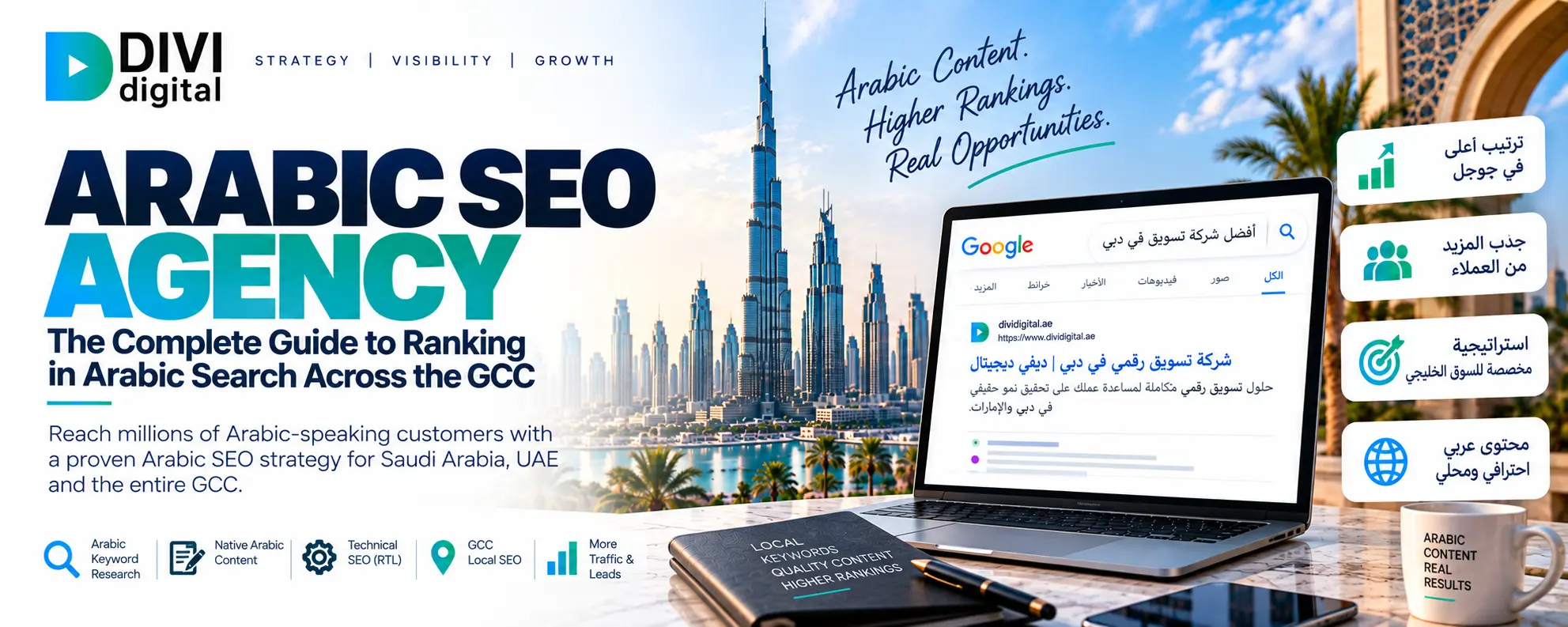
Choosing an Arabic SEO agency is not the same as choosing any other SEO partner. Arabic search has its own grammar, its own dialects and its own technical rules. Get it wrong and your site stays invisible to millions of Gulf buyers.
We have spent 5+ years in SEO and delivered 150+ projects. This guide explains how Arabic SEO really works, what a good Arabic SEO company should do for you, and how to spot the ones that only translate your English pages and hope for the best.
Read it before you sign anything.
What Does an Arabic SEO Agency Actually Do?
An Arabic SEO agency helps your website rank in Arabic-language search results. That means Google first, and now AI search tools like ChatGPT and Google AI Overviews too.
A proper Arabic SEO services package covers six areas:
- Arabic keyword research and mapping based on real search behavior
- Arabic content localization that goes beyond translation
- Arabic technical SEO audit with right-to-left (RTL) fixes
- Arabic link building from regional and Arabic-language websites
- Local and e-commerce SEO, including Google Business Profile in Arabic
- Reporting that ties rankings to leads and sales
If an agency can't explain each of these in plain words, keep looking.
Arabic SEO Company vs. Regular SEO Agency: What Is Different?
A regular agency can run a great English campaign and still fail in Arabic. The reasons are practical.
- Arabic is written right to left, and that affects layout, code and user experience.
- One root word can produce many forms, so keyword research is harder.
- Spelling varies. Users often swap the different forms of the letter alef, so one word can be typed several ways.
- People search in Modern Standard Arabic and in local dialects.
- Keyword tools hold far less Arabic data than English data.
So a good Middle East SEO agency does not copy an English playbook. It builds a separate Arabic strategy, then connects it to your wider marketing.
Why GCC Market SEO Is Worth the Investment
The Gulf Cooperation Council (GCC) includes Saudi Arabia, the UAE, Qatar, Kuwait, Bahrain and Oman. These are high-income markets with heavy smartphone use and a strong habit of shopping online.
Many brands still serve them only in English. That leaves real room for Arabic content to win organic traffic, especially on long-tail searches where competition is thin.
GCC market SEO helps you:
- Reach buyers who prefer to search and purchase in Arabic
- Build trust faster, because Arabic content shows you respect the market
- Grow Gulf market organic reach without paying for every click
Each country behaves differently, though. Treating the Gulf as one audience is a common and costly mistake.
Saudi Arabia SEO Services
Saudi Arabia is the largest market in the region. Arabic is the default search language for most users, and local platforms like Salla and Zid matter for e-commerce. Strong Saudi Arabia SEO services focus on Arabic-first content, Saudi-specific search terms and local trust signals.
UAE Arabic Digital Marketing
The UAE is more mixed. Many users search in English, Arabic, or both in the same session. Good UAE Arabic digital marketing runs bilingual pages, clean language switching and keyword targets for each audience, instead of forcing everyone into one version.
Qatar, Kuwait, Bahrain and Oman
These markets are smaller, but they can be very profitable for the right products. Regional keywords and local dialect terms often make the difference between ranking and being ignored.
Why Native Arabic SEO Experts Matter
Every agency claims it has Arabic skills. Ask for proof.
Machine translation, even good machine translation, reads stiff. Native readers notice within a sentence. They leave the page, and that behavior sends the wrong signal to search engines.
Real native Arabic SEO experts bring three things:
- Natural writing. Content drafted in Arabic, not translated from English.
- Tone control. They know when to be formal and when to sound conversational.
- Cultural awareness. They know which words, images and offers fit each country.
Ask to see Arabic writing samples. Have a native speaker you trust read them. It takes ten minutes and can save you months.
MSA vs. Local Dialects: How Arabic Users Really Search
This is the gap most agencies skip.
Modern Standard Arabic (MSA) is the formal written language. News sites, official documents and most business pages use it. But many people don't type searches the way they write articles.
In the Gulf, users often search with Khaleeji terms. In other regions you will see Egyptian or Levantine phrasing. The same product can be searched in very different ways depending on who is typing.
What that means for your content:
- A page written only in MSA can miss dialect-based searches.
- A page written only in dialect can feel unprofessional and miss formal searches.
- The best approach uses MSA as the base and works dialect terms naturally into headings, FAQs and supporting copy.
When you interview an agency, ask how it handles this. "We use a keyword tool" is not a good answer. Most tools have thin Arabic data and rarely separate dialects. Strong teams combine tools with manual SERP checks, autocomplete research and native-speaker judgment.
Arabic Keyword Research: Our Step-by-Step Process
Arabic keyword research needs extra steps because of root words, spelling variation and attached prefixes like the definite article. This is the process we follow:
- Build the seed list. Start from your products, services and customer questions in both Arabic and English.
- Collect variants. Spelling differences, plural forms, dialect terms and country-specific wording.
- Check search intent by hand. Open the Arabic search results and see what Google actually ranks: service pages, blogs, videos, forums or product listings.
- Map keywords to pages. One primary keyword per page, with close variants grouped together instead of creating thin duplicate pages.
- Split by country. A term that works in Riyadh may be rare in Dubai.
- Prioritize. Rank opportunities by business value, difficulty and how fast you can publish.
The result is a clear keyword map your team can use, not a giant spreadsheet nobody opens.
Arabic Content Localization and Culturally Sensitive Content Marketing
Localization is not translation. Translation changes the words. Localization changes the message so it fits the reader.
Good Arabic content localization looks at:
- Tone. Formal for banking and legal pages, warmer for retail and lifestyle.
- Idioms and examples. English phrases rarely work word for word.
- Imagery. Photos, colors and layouts should suit regional norms.
- Offers and seasons. Ramadan, Eid and National Day campaigns need their own content plans.
This is also where culturally sensitive content marketing pays off. Content that respects local values earns more trust, more shares and more links. Content that ignores them can damage your brand in a single post.
Arabic Technical SEO Audit: RTL Web Optimization Done Right
Most technical SEO checklists assume left-to-right text. Arabic websites break those assumptions in quiet ways.
A proper Arabic technical SEO audit checks:
- Direction and language attributes. Pages need dir="rtl" and lang="ar" set correctly.
- Bi-directional text. Arabic mixed with English words, numbers or brand names can scramble the order of text.
- CSS layout flipping. Menus, sliders, buttons and forms that were never properly mirrored.
- Font loading. Arabic fonts are heavy and can slow your pages down. Bad choices hurt Core Web Vitals.
- Structured data. Schema markup should use correct Arabic values and match what users see.
- Mobile performance. Most Gulf searches happen on phones, so speed and usability come first.
- Indexing and internal links. Clean crawling, correct canonicals and working navigation.
This is what we mean by Right-to-Left (RTL) web optimization. It is technical work, and it is where many Arabic sites quietly lose rankings.
Subdirectory, Subdomain or Country Domain?
This choice affects your SEO for years, so decide early.
- Subdirectory (example.com/ar/): usually the simplest. It shares authority with your main site and is easier to maintain.
- Subdomain (ar.example.com): can work, but search engines may treat it more separately, so you build authority twice.
- Country domain (example.ae, example.sa): a strong local signal, but the most work and cost.
Hreflang Setup for Arabic Sites
Use hreflang tags so Google shows the right version to the right user. Use region codes like ar-SA and ar-AE when your content really differs by country. Link each language switcher to the matching page, not just the homepage. Wrong hreflang is one of the most common Arabic SEO errors, and one of the easiest to fix.
Arabic E-Commerce SEO: Salla, Zid, Noon, Amazon.sa and Shopify
Most agency pages mention Shopify and WooCommerce. Fewer talk about the platforms Gulf shoppers actually use.
- Salla and Zid. Popular Saudi store platforms with their own rules for URLs, templates and metadata.
- Noon and Amazon.sa. Marketplace SEO is its own skill. Titles, bullet points and backend keywords all matter, and Arabic listings need the same dialect and keyword care as web pages.
- Shopify and WooCommerce. Still widely used. Arabic stores on these platforms need RTL themes, translated product data and proper hreflang.
- Google Business Profile in Arabic. Business name, categories, descriptions and reviews should all work in Arabic.
Before hiring, ask any agency: "Have you optimized stores on Salla or Zid?" Their answer tells you a lot.
Arabic Link Building That Earns Real Authority
Backlinks from English sites help. But Arabic rankings respond strongly to links from Arabic and regional sources.
Strong Arabic link building includes:
- Digital PR with regional news and business outlets
- Guest content on respected Arabic blogs and industry sites
- Local directories and chambers of commerce
- Partnerships with regional publishers and creators
Be careful with bulk link packages from low-quality Arabic sites. They look like a quick win, then cause trouble later. Ask to see example sites before any campaign starts.
Arabic SEO and AI Search: Getting Cited by ChatGPT and Google AI Overviews
People now ask AI tools questions in Arabic. These tools pull from web content to build answers. If your brand is not a clear source, you will not be cited.
Generative Engine Optimization (GEO) means making your content easy for AI systems to understand and quote. For Arabic, that means:
- Direct answers near the top of each section
- Question-style headings that match how people ask
- Clean structure and schema so machines can read the page
- Strong brand signals: consistent business details, reviews and mentions on trusted sites
- Original information, like local insight, real examples and expert comments
Nobody can promise a place in AI answers. Be wary of anyone who does. But agencies that understand this shift are better prepared for where search is going.
Arabic SEO Services Pricing: What Affects the Cost
Many agencies hide pricing behind a contact form. That makes comparison hard, so here is how it usually works.
- Single-market campaign (for example, UAE only): one language setup, one keyword set, local link building.
- Multi-country GCC campaign: more research, country-specific content and wider link building.
- E-commerce campaign: priced by catalog size, platform and how much content must be created.
- One-off audit or technical project: a fixed scope. Useful for fixing structure and hreflang before a long retainer.
The main cost drivers are:
- Number of target countries
- Number of pages and products
- Amount of new Arabic content needed
- Competition in your niche
- Whether link building is included
A good agency gives you a scoped proposal with clear deliverables, not just a monthly number.
How Long Does Arabic SEO Take?
Most sites see meaningful movement in three to six months. That is a realistic range, but it depends on your starting point.
Results come faster when:
- Your site already has some authority
- Competition for your Arabic keywords is weak
- Technical problems are fixed early
They take longer when you start with a brand-new domain or a very competitive niche.
Be cautious with case studies that show huge percentages and no context. Growth from 20 visits to 120 sounds big and means little. Ask for starting numbers, the timeframe and what was actually done.
Why Businesses Trust Our Arabic SEO Work
Trust is the real deciding factor when you hire an Arabic SEO agency. You are handing over your visibility in a market where mistakes are hard to spot.
Here is what we can put on the table:
- 5+ years of hands-on SEO experience. We have worked through algorithm updates, platform changes and the rise of AI search.
- 150+ projects delivered. Across industries and business sizes, from small local companies to larger brands.
- Clear scopes and honest timelines. We tell you what is realistic before work starts.
- Transparent reporting. You see which pages moved, which keywords improved and what it means for leads.
- No guaranteed rankings. Anyone who guarantees page one is guessing or lying.
We would rather earn your trust with a straight conversation than win a contract with big promises.
How to Choose a Middle East SEO Agency: 8 Questions to Ask
Use these on your first call:
- Who writes the Arabic content, and can I see samples?
- How do you handle MSA versus dialect search behavior?
- How do you do Arabic keyword research when tool data is limited?
- Which URL structure do you recommend for my site, and why?
- How do you set up hreflang for several Gulf countries?
- Have you worked on Salla, Zid, Noon or Amazon.sa?
- Where will my backlinks come from?
- How will you report progress, and which numbers will you share?
Clear, specific answers are a good sign. Vague answers are a warning.
Red Flags When Hiring an Arabic SEO Company
- Guaranteed rankings or "page one in 30 days"
- Machine-translated content with light editing
- No Arabic samples or case studies
- Bulk link packages with no site list
- One strategy for every Gulf country
- No mention of RTL technical issues
Final Thoughts
Arabic SEO rewards the businesses that do it properly. Competition is often thinner than in English, the audience is valuable, and trust carries a lot of weight.But the work is specialized. You need native-quality writing, dialect-aware research, RTL-ready technical setup, regional links and a plan for AI search. An Arabic SEO agency that covers all of it can build traffic that lasts.
Start small if you need to. Run an audit, fix the foundation, then grow market by market.
Ready to see where your site stands in Arabic search? Get in touch for an audit and a clear, scoped plan.
Frequently Asked Questions About Arabic SEO
What is an Arabic SEO agency?
An Arabic SEO agency is a team that helps businesses rank in Arabic-language search results through keyword research, localized content, technical optimization and link building.
Is Arabic SEO different from English SEO?
Yes. Arabic has right-to-left layout, dialect differences, root-based word forms and less keyword tool data. These change how research, content and technical work are done.
Which countries should I target first?
Start where your customers and revenue are. For many businesses that is Saudi Arabia or the UAE, then expand to Qatar, Kuwait, Bahrain and Oman.
Do I need separate content for each GCC country?
Not always. You can share a strong MSA base, then adjust keywords, examples and offers for each market where search behavior differs.
Can Arabic SEO help me appear in AI search results?
It can improve your chances. Clear answers, good structure and strong brand signals make your content easier for AI tools to use. No one can guarantee citations.
How long before I see results?
Usually three to six months, depending on your site, your niche and how quickly technical issues are fixed.